This is the symbol for KA:
𐘾
It’s a lovely, simple symbol, just a circle with a cross in the middle. Grab a pen and draw five of them right now. Don’t scroll down until you’re done.
.
.
.
.
.
.
.
.
.
.
.
.
Got your five KAs? Excellent.
This is how Minoan scribes wrote KA:
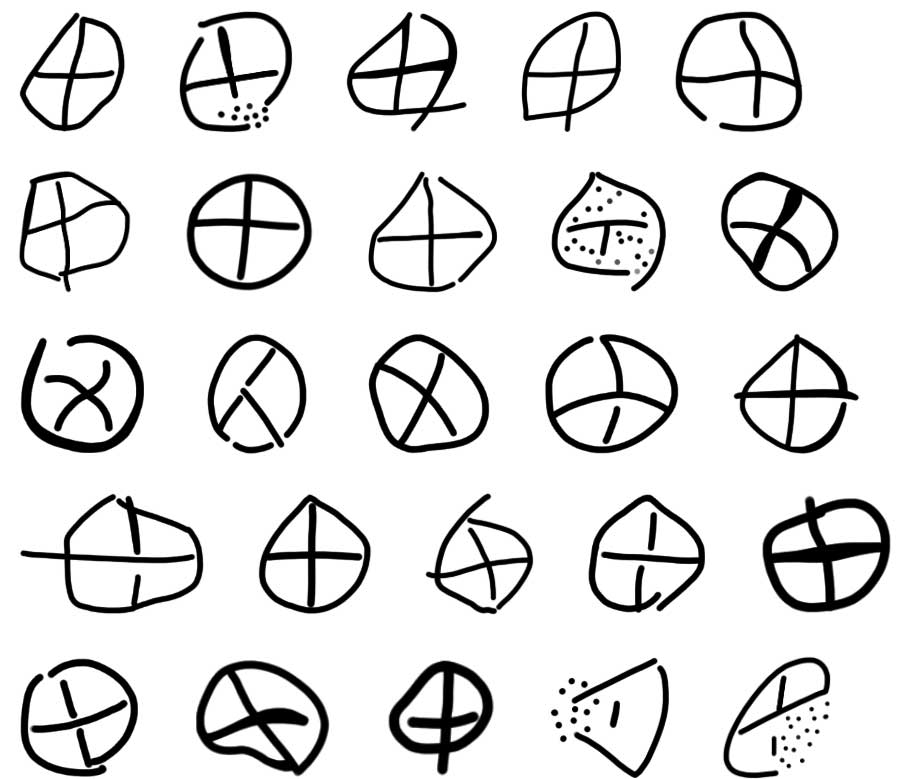
The spattered dots indicate where an inscription is damaged.
They must have been writing with their feet.
This is the reality of Linear A tablets: messy, hurried, slapdash. Tablets were scratch paper. Scribes used them to compose a rough draft, then copied the text onto papyrus for permanent storage. No one important was going to see the tablets; they didn’t have to be written any more neatly than the scribes needed to finish their work.
On top of that, the scribes were working in the wrong medium. Linear A was designed to be written in ink on a flat surface. It has long lines that cross frequently, both features that work well in ink. But when you drag a stylus across clay, the stylus displaces the clay, creating crumbles on both sides of the line. Drawing one line across another deforms the first line and creates what looks like a break on either side of the second line. Even drawing two lines too close together can create problems–the displaced clay distorts the lines around it. The best way to avoid distorting a symbol in clay is to draw the symbol fairly large, so the lines are far enough apart that the displaced clay affects the other lines less. Or alternatively, don’t care too much about neatness.
(This is not to say that it’s impossible to write this type of script neatly on clay. Mycenaean Greek scribes’ Linear B handwriting is a drastic improvement over Linear A. We don’t know why; possibly they were better trained, had more practice, and were held to higher standards than Minoan scribes. However, neither Linear A nor Linear B scribes ever got anywhere near the tiny, calligraphically perfect handwriting of scribes working in cuneiform, a script designed to be written on clay.)
Now compare your five KAs with the picture above. Your symbols are more regular, more tidy, and more similar to one another. Your crosses are all upright. As a member of a hyperliterate culture, you were trained to write from early childhood, and regardless of how messy your writing is by modern standards, your training shows. There’s nothing saying you can’t write Linear A neatly, but if you want to reproduce the authentic hand of a Minoan scribe, you must embrace the scrawl.
The key is to start by learning how to write each symbol in the form the Minoan scribes were aiming for–the Ur-form, you might say. (Figuring out what the Ur-form was is a skill you’ll develop over the next several lessons.) Being able to write this form neatly is useful for writing on paper, since Minoan scribes probably did have excellent handwriting when writing formal documents on papyrus. Then, when you move from paper to clay, you still have the option of writing neatly, but you’ll also be able to let your handwriting deform in ways that will look authentic.
Updated 10/15/2025