Almost every script has a formal version, an exemplar that you can copy to write the script accurately. For example, here’s the Greek alphabet:
Α α , Β β , Γ γ , Δ δ , Ε ε , Ζ ζ , Η η , Θ θ , Ι ι , Κ κ , Λ λ , Μ μ , Ν ν , Ξ ξ , Ο ο , Π π , Ρ ρ , Σ σ ς , Τ τ , Υ υ , Φ φ , Χ χ , Ψ ψ , Ω ω
If you copy this alphabet you won’t have the most refined hand, but you’ll be able to print legible Greek. You’ll also have a good enough knowledge of the basic letterforms to read printed Greek and to learn how to write, say, cursive Greek. As evidence of how basic this alphabet is, it appears in ASCII and Unicode.
Linear A has never been formalized in quite the same way. There are versions of Linear A symbols that scholars use, but there’s no typeset for them–scholars hand-write them into their books. There’s no manual for writing Linear A; each person picks it up from their professors. There IS a Unicode version of Linear A, which has been copied by all of the available Linear A fonts, and appears in non-scholarly online sources as a trusted and reliable version of the script. People have even written papers on the similarities between ancient scripts using the Unicode version of Linear A as a basis. But the Unicode version… lies.
Here’s the Unicode character for MA:
𐙁
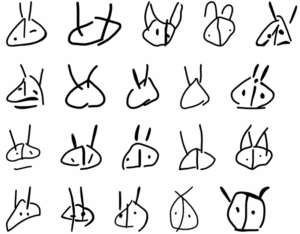
Here are some examples of MA from a single site, Haghia Triada:
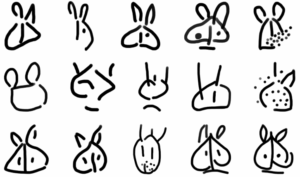
Here’s another site, Zakros, where round ears were in fashion:
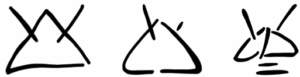
In Khania they went all in on the “triangle with two sticks” form:
And here’s MA’s likely equivalent in Cretan Hieroglyphs:
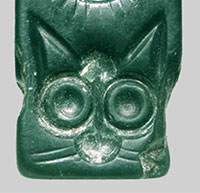
You can see where the “triangle with two sticks” form came from. There are even instances where Minoan scribes drew something similar to 𐙁. But the scribes were drawing a stylized cat face, and most versions of the symbol show a rounded face, two eyes, and a nose-line. Even the simple versions show more cat-like placing of the ears and a broader-based triangle than the Unicode symbol.
The Unicode symbol is a simplified version of the simplest–and rarest–variation of MA, stylized beyond the point that any Minoan scribe attempted. It’s a terrible exemplar. Put bluntly, it lies.
So how do you work out which version of MA to copy?
That’s a question you’ll ask for almost every symbol in Linear A. Each symbol varies by location, within a location there are variations, and no scribe wrote neatly enough that you can pick out an example and say, “This one. This is what everyone was trying to write.”
But it’s not that hard! The next several lessons will give you the tools to evaluate symbols and decide which parts of the symbol are important and which version to incorporate into your personal Linear A writing.
Note: It may have occurred to you to ask, “If there’s no accurate version of the Linear A syllabary, why don’t you make one yourself?” An excellent question, and one I congratulate you on not asking out loud, because the answer is embarrassing.
You see, I’m still learning Linear A. I understand how it goes together, I can scan and analyze tablets, I’ve spent plenty of time squinting at columns of symbols in SigLA, but I don’t know all the individual symbols. Writing these lessons is part of how I’m teaching myself. By the time I’m done, I may have an exemplar script that people can copy. But in the meantime, everyone gets a bootcamp in how to analyze Bronze Age paleography.
Updated 10/16/2025