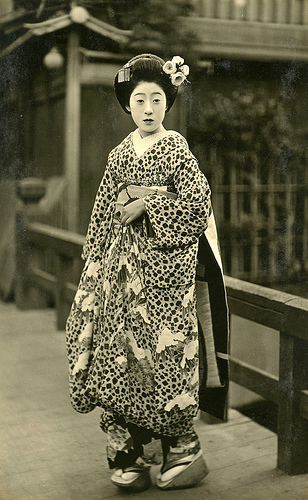
When a girl becomes a maiko, an apprentice geisha, she takes a professional name (geimei (芸名) or, in older usage, geimyô, “artistic name”) to symbolize her new life. These names are flamboyant, describing the bearer’s beauty, youth, or alluring clothes and perfume; they’re vivid, comparing the bearer to flowers, jewels, and gold; and they’re aspirational, wishing the bearer a long life, many blessings, much wealth, and good fortune. They reflect not only the splendor of the flower and willow world, but the uncertainty of a life spent on the cutting edge of fashion and the raw edge of society.
Lafcadio Hearn waxes effusive about the names of the geisha he knew in the late 19th century:
But there are many geimyo here, ‘artistic names,’–names of mischievous geisha who worship the Golden Kitten, written by their saucy selves: Rakue and Asa and Wakai, Aikichi and Kotabuki and Kohachi, Kohana and Tamakichi and Katsuko, and Asakichi and Hanakichi and Katsukichi, and Chiyoe and Chiyotsuru. ‘Fortunate-Pleasure,’ ‘Happy-Dawn,’ and ‘Youth’ (such are their appellations), ‘Blest-Love’ and ‘Length-of-Days,’ and ‘Blossom-Child’ and ‘Jewel-of-Fortune’ and ‘Child-of-Luck,’ and ‘Joyous-Sunrise’ and ‘Flower-of-Bliss’ and ‘Glorious Victory,’ and ‘Life-as-the-Stork’s-for-a-thousand-years.’
from Glimpses of Unfamiliar Japan
These names, which express such lighthearted joy, are not chosen lightly at all. Geimyo are artists’ names, just as much as the stage names of No actors or traditional singers, and though geisha do not pass on their names unchanged like other artists, their names do express their place in their lineage. Each new geisha is placed under the wing of an older and more experienced geisha, her oneesan or “older sister,” who helps to teach her the social skills needed in the hanamachi and uses her influence to launch the new geisha in society. The younger geisha takes one element of her older sister’s name as her own: Tamaryô, “Jewel Dragon,” might sponsor Tamakichi, “Jewel of Fortune,” who might sponsor Tamayu, “Excellent Jewel.” The spelling of the shared element doesn’t change, and the element doesn’t change position within the name—Tamayu’s younger sister would not be named Kotama, “Little Jewel.”1
The second element is chosen based on a combination of fashion and fortune. Fashion, because geimei elements go in and out of style, and fortune, because names are believed to affect the fortune of the bearer. There are at least two ways to determine an auspicious name. In his essay on Japanese female names, Lafcadio Hearn describes an old system in which the sound of the Chinese reading of the first character of the name had to match the bearer’s birth element. (For more information, see Shadowings, “Japanese Female Names,” page 144.) A more recent method is to count the number of strokes in the name and compare it to… to something. According to Japanese people who have talked about the system online, there’s more than one method, they’re all fabulously complicated, and Japanese people who take it seriously go to priests and other specialists to make sure they get it right. If you Google 名づけ (nazuke, “naming”), you can find Japanese sites that explain various systems or do the calculations for you. Geisha used to be known for their reliance on luck and superstition, so stroke count was probably very important in the past. How important it is to modern geisha probably varies widely.
Once established, geishas’ name lineages can go on for several decades—an eternity in a business where turnover is high and careers are short.2 The Ichi- line started by Ichiko in 1916 is still going strong in Pontocho. Even the eccentric Uno- line that began in Pontocho in the 1920’s lasted through at least the 1950’s, and possibly even later.
Masculine Geimei
Quite a few geisha, especially 18th- and 19th-century geisha, have names with male endings: Aitarô, Hatsutarô, Kotarô, Mametarô, Tamatarô; Fukusuke, Harusuke, Tamasuke, Unosuke, Utanosuke. While explanations are thin on the ground, one Japanese commenter suggests that the tradition began as an Edo-period attempt to get around restrictions on female geisha. Male geisha weren’t as heavily policed as female geisha because male geisha weren’t involved in prostitution; so if the local commissioner saw a male name on the list of newcomers to the district, and he didn’t care to follow up in person…
Having a male name would have seemed dashing. Stylish women had been appropriating male symbols since at least the 12th century, when the shirabyôshi danced before the imperial court wearing men’s clothing and carrying a sword. By the early 1600’s, trendy young girls might dress their hair like men, even dress themselves like men, following the fashions set by the cross-dressed actress/prostitutes who pioneered a hot new style of theater called “kabuki.” The trends were subtler by the mid-1700’s, when female geisha began their rise to prominence, but masculine touches still looked daring, high-spirited, gallant. When female geisha wore men’s jackets and took on a man’s profession, why be surprised when some of them took on men’s names?
Name Elements
Geimei are constructed of a surprisingly small number of elements. To spell most names of the pre-war era, you would need fewer than 150 kanji. Even after it became fashionable to play with spellings, the same 150 kanji get heavy use; and even if a modern name is spelled completely differently, it may sound exactly like a name from the 1800’s. Modern geishas’ names are still full of Kimi- and Kiku-, Tsuru- and -zuru, Mame- and -chiyo and Teru- and -kichi. Just like geisha themselves, geimei are a blend of adaptation and tradition.
Updated 12/16/2014
- However, not all geisha have an older sister. In the past, a geisha who retired and then returned to work often took a new geimei, and may not have had an older sister sponsoring her; geisha who moved between hanamachi also tended to take new names, and may not have had older sisters. In recent decades, quite a few maiko have simply debuted alone, for reasons not known to the public. How did these geisha choose their geimei? Some joined an okiya that was known for a particular name element, so the maiko adopted that element and joined the lineage without having it transmitted to her by an older sister. For the rest of the geisha, there’s not enough information in English for us to say. ↩︎
- The well-respected geisha practicing her arts into her 40’s, 60’s, or even later is the exception, not the rule. Historically, most geisha left the business early, whether for security or to escape exploitation. Nowadays many women don’t even make it out of the maiko stage. The respected role of older women in the geisha community must be balanced against the reality that for most women, being a geisha is a young woman’s game. ↩︎